In the high-stakes world of industrial manufacturing, every minute of unplanned downtime can be a direct hit to the bottom line. When a machine fails, the pressure falls on maintenance technicians and procurement managers to identify and source replacements instantly. Often, they are forced to work with nothing more than a worn component, a faded serial number, or a blurry smartphone photo.
This is the friction that spare parts digitalization can eliminate. By building a robust, self-service aftermarket portal, manufacturers empower customers to find and purchase parts with precision—reducing downtime, improving customer satisfaction, and capturing untapped aftermarket revenue.
In this blog, we’ll cover how spare parts digitalization can build a robust self-service aftermarket portal that empowers customers to search, find, and buy parts without the friction of identifying the right replacement part to keep aging equipment online.
What is Spare Parts Digitalization?
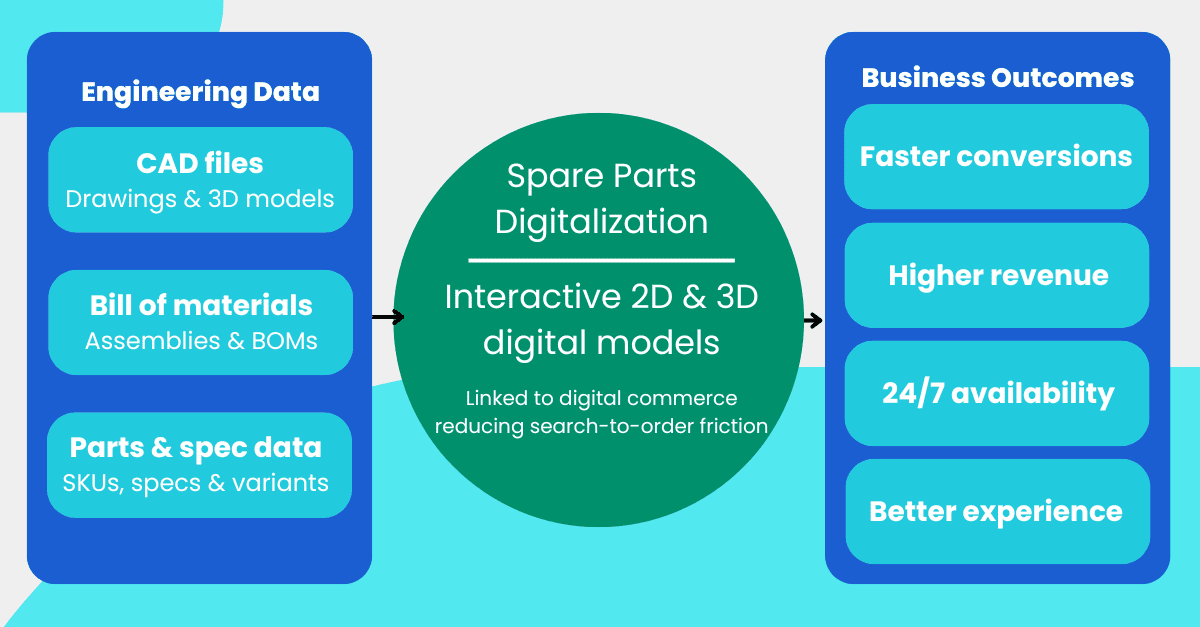
Spare parts digitalization in manufacturing is the process of transforming parts data into interactive 2D and 3D digital models that can enable fast, accurate spare parts identification and seamless online ordering.
By connecting engineering data (CAD, BOMs, and parts data) to digital commerce, manufacturers reduce friction in the search-to-order journey—driving faster conversions, higher aftermarket revenue, 24/7 accessibility to parts, and improved customer experience.
Figure 1: spare parts digitalization flowchart
Original Equipment Manufacturing Spare Parts Challenges
The industrial equipment manufacturing sector operates within a complex ecosystem. When industrial equipment shuts down abruptly, the cost of that unplanned downtime can be substantial. Research by Deloitte shows that unplanned downtime cost industries an estimated $50 billion each year.
Given that most industrial equipment catalogs routinely contain 50,000 to 500,000+ SKUs spanning decades of model years and complex compatibility requirements, it is often difficult to maintain accurate and clean parts data.
With the hefty financial impact of unplanned downtime on their bottom lines and on their customers, industrial manufacturers cannot afford to impose additional burdens on their often-stressed customer base.
What “Spare Parts Digitalization” Actually Means
The solution to this challenge is the digitalization of spare parts inventory. This helps manufacturers provide digital representation (digital twin) of spare parts in an interactive 3D/2D model for easy and faster part identification to quicken the search-to-buy journey in a 24/7 service portal.
The benefits of this can be enormous, from boosting customer confidence in your brand, expanding aftermarket parts sales promotions, empowering customers with always-on self-service experience, and measuring the impact of guided selling to your bottom line. To help tailor your digitalization strategy to your business needs, it is important to understand what spare parts digitalization means to equipment manufacturers.
What Are The Three Foundational Steps to Digitalization Success?
Digitalization in this context involves more than simply moving a parts catalog online. It involves three steps:
Digital Spare Parts Data and Catalog Intelligence
The foundation for spare parts digitalization is a clean, enriched, machine-readable product information layer—every SKU with complete technical specifications, cross-reference data, imagery, compatibility rules, supersession chains, and compliance certifications. Without this, no downstream technology can perform reliably.
AI-powered data deciphering and cleaning tools have incredible pattern recognition skills that help crack even the most obscure data and automatically convert them into a uniform and analyzable structure. AI data cleaning can enable even deeper use cases by unearthing hidden relationships and patterns within disparate data sets. It can map the hidden connections between seemingly unrelated data points, revealing trends, uncovering anomalies, and predicting future events, such as repairs and the parts needed. Equipment failures become predictable, and market shifts emerge from previously untapped intelligence.
Because spare parts data is often spread across multiple systems, tools, and processes, it is easy for poor‑quality data to exist without being noticed. These issues often only become apparent during a digital transformation initiative, when the data is brought together and examined more closely.
AI-Driven Identification and Search
At the core of successful spare parts digitalization implementation is accurate image recognition. Often, traditional keyword search fails in industrial environments because buyers—maintenance technicians, field engineers, and procurement coordinators—frequently cannot name the part they need. They have a worn component in hand, a photo of a failed assembly, or a vague part number from a 20-year-old machine.
AI-powered technology can significantly improve this process by leveraging visual search to close this gap by matching images against catalog embeddings.
Technicians can now identify spares instantly using visual search recognition—snapping a photo or capturing a serial number—which reduces time wasted on manual part lookup, cuts order errors, and speeds repairs.
Integrated ERP & PLM Commerce
A dynamic pricing structure and real-time add-on recommendations work if the underlying data stays accurate. Disorganized procurement can result in redundant purchases, missed volume discounts, and costly expedited orders when critical spares are not on hand. Digitalization replaces static inventory management with dynamic, analytics-driven systems. Modern systems consolidate data from work orders, field operations, and warehouse transactions to achieve precise visibility and ensure that the right parts are available when needed—replacing static safety stock rules with dynamic, usage-based buffers.
The Three Strategic Value Drivers to Digitalization
Aftermarket Revenue Growth.
Parts sales typically provide gross margins of over 30%, compared with an average of 10% for maintenance services—making aftermarket parts the most substantial contributor to annual services revenue for most OEMs (McKinsey). A superior digital parts experience—faster identification, self-service ordering, and AI-driven cross-selling—can directly capture more of the aftermarket spend that currently leaks to distributors or competitors.
Working Capital Efficiency.
Overstocked and obsolete inventory is a hidden balance sheet problem. Companies using smart inventory systems have reduced carrying costs by up to 30% while increasing the availability of high-demand spares. The shift from static reorder points to demand-signal-driven replenishment is the single most impactful working capital lever available to most industrial operations leaders.
Data as a Strategic Asset.
Every visual search query, every parts order, and every abandoned cart is a demand signal. Manufacturers who own the digital parts experience own this data—and can feed it into product development, inventory planning, pricing strategy, and customer retention programs. Those who cede the experience to distributors cede the data as well.
What Leaders Are Doing Now
The manufacturers capturing first-mover advantage in this space share three common characteristics.
They have unified their product data into a single source of truth—typically a Product Information Management (PIM) system synchronized in real time with their commerce and ERP infrastructure.
They have embedded AI-powered visual search directly into their buyer experience rather than treating it as a standalone tool.
And they have built closed-loop analytics that tie parts search behavior to order outcomes, feeding those signals back into inventory and product strategy.
The average manufacturer faces an estimated 800 hours of equipment downtime annually. Spare parts digitalization is the operational infrastructure that systematically reduces that number—while simultaneously growing the aftermarket revenue that funds it.
The bottom line for VP-level decision makers: spare parts digitalization is not an IT initiative. It is a margin protection, revenue growth, and competitive positioning strategy—and the window for differentiated advantage is narrowing as both distributors and digital-native competitors accelerate their own investments.